There is a particular moment in every scavenger hunt when something clicks. A cryptic clue suddenly makes sense, a team rounds a corner and finds exactly what they were looking for, a child figures out a riddle before the adults do. That moment — the small triumph of having worked something out — is what good scavenger hunt clues are designed to produce. This guide covers the main types of clues, offers ready-to-use examples across age groups and settings, and provides a practical framework for designing original sequences that hold attention from start to finish.

The Main Types of Scavenger Hunt Clues
Before reaching for a specific format, understanding what each clue type demands from participants helps with design decisions. Different clue formats activate different cognitive skills — observation, deduction, physical memory, creative thinking — and mixing them creates a more varied and sustaining experience than relying on a single type throughout.
Riddle-Based Clues
Riddle clues describe an object or location indirectly, requiring participants to decode the description before knowing where to go or what to find. They reward lateral thinking and vocabulary, and they work at almost any age when calibrated correctly. The difficulty lever is the abstraction level: younger participants need concrete, sensory descriptions; older participants and adults respond well to wordplay, double meanings, and misdirection.
Photo and Observation Clues
Photo clues ask participants to find and photograph a specific object, person, or location — or to recreate a described scene. They are particularly effective for outdoor and team-based hunts because they require physical movement and produce a submission artifact that can be reviewed, scored, and shared after the event. Observation clues that ask participants to document what they notice at a specific site extend naturally into educational contexts, where the act of looking carefully is itself a learning objective.
Trivia and Knowledge Clues
Trivia clues require participants to answer a question before receiving the next location or item. They can be general knowledge, subject-specific, or local — tied to the geography, history, or culture of the space where the hunt takes place. Trivia clues work well for educational hunts and corporate events where the content can be aligned to professional knowledge or company history.
GPS and Location-Based Clues
GPS clues direct participants to a specific geographic coordinate, where they encounter the next challenge upon arrival. This format requires a mobile device and a compatible platform, but produces a uniquely immersive experience — participants must physically navigate to each point rather than simply reading a description of where to go. GPS clues are particularly effective for outdoor environments, campus explorations, city tours, and heritage site visits.
Physical Task and Challenge Clues
Task clues require participants to perform an action — complete a physical challenge, build something, act out a scenario, or demonstrate a skill — before earning the next clue. They introduce a kinetic element that works especially well with children and in team-building contexts where the social dynamic of completing a shared task is part of the value.
Scavenger Hunt Clues for Kids
Clues designed for children need to be concrete, short, and achievable without adult assistance. The best children’s clues describe objects through sensory details — color, shape, texture, function — and use rhyme or rhythm to make them memorable and enjoyable to read aloud.

Indoor Clues for Young Children (Ages 5–8)
📍 I keep your food cold and your drinks even colder. Open my door and look on my shoulder. (Refrigerator — check the top shelf)
📍 I’m full of bubbles when you turn me on. Scrub-a-dub-dub — your next clue is gone. (Sink or bathtub)
📍 I hold all your stories but never read one. Find me where quiet and adventure are done. (Bookshelf)
📍 I wake you up every single day. Your next clue is resting near where you lay. (Bedside table or alarm clock)
Outdoor Clues for Children (Ages 8–12)
📍 I stand in the yard and reach for the sky. Birds love to perch on me — can you tell why? (Tree)
📍 You run past me every day on your way out. I open and close without a shout. (Front door or gate)
📍 Flowers grow near me and butterflies land. Your clue is hidden close at hand. (Garden bed or flower pot)
📍 I have four legs but I never walk. I hold your lunch without any talk. (Picnic table)
Scavenger Hunt Clues for Teens
Teenagers respond well to clues that assume intelligence and reward cleverness. Wordplay, cultural references, and challenges that involve some element of competition or social interaction tend to land better than straightforward riddles. This age group also engages readily with photo and GPS-based missions, particularly when the hunt involves moving through outdoor or urban environments.
Riddle and Wordplay Clues
📍 The more you take, the more you leave behind. Find me outdoors — I’m a trail of a kind. (Footsteps / footpath)
📍 I run but never walk, have a mouth but never talk, have a bed but never sleep. (River or stream)
📍 I have cities but no houses, mountains but no trees, water but no fish. What am I? (A map — find the map display or atlas)
Photo Challenge Clues for Teens
📍 Find something that represents your city in a single photograph. No people allowed.
📍 Recreate a famous painting using only objects you can find within 50 meters of here.
📍 Photograph five things that are the same color as the sky right now.
Scavenger Hunt Clues for Adults
Adult scavenger hunt clues work best when they assume knowledge, incorporate layers of meaning, or require genuine problem-solving. The most effective adult clues combine a cryptic description with a location that makes sense once decoded — creating a satisfying moment of recognition when participants arrive. Adults also respond well to clues that incorporate local history, cultural knowledge, or professional context.
Cryptic and Lateral Thinking Clues
📍 Napoleon never stood here, but he would have approved: a place where order meets symmetry and geometry meets ambition. (Town hall, plaza, or formal garden)
📍 Where words go to rest but ideas never sleep. (Library)
📍 The oldest resident of this street has been here longer than anyone remembers and has never once moved. (A large, old tree)
📍 Find the place in this building where people gather to celebrate the end of something. (Exit, reception area, or bar)
Knowledge and Trivia Clues for Adults
📍 This architectural style emerged in the 1920s and favored geometric forms and bold color. Find one example within three blocks and photograph the detail that gives it away.
📍 Name the year this building was constructed. Your next clue is at the location marked by that same number on the street.
Team Scavenger Hunt Clues for Corporate Events
Corporate scavenger hunt clues serve a dual purpose: they engage participants in the activity while simultaneously encouraging the collaboration, communication, and problem-solving behaviors that team-building exercises are designed to develop. The best corporate clues require coordinated effort — tasks that one person cannot complete alone, decisions that require group input, or missions that reward division of labor.

Collaborative Mission Clues
📍 Every team member must contribute one fact about themselves that no one else knows. Compile them and deliver the list verbally to the hunt coordinator for your next clue.
📍 Build the tallest freestanding structure you can using only materials found within 20 meters of this spot. Photograph it with every team member visible. Minimum height: 30cm.
📍 Interview three people outside your team and ask them each the same question. Compile their answers and be ready to present a summary.
GPS-Based Corporate Clues
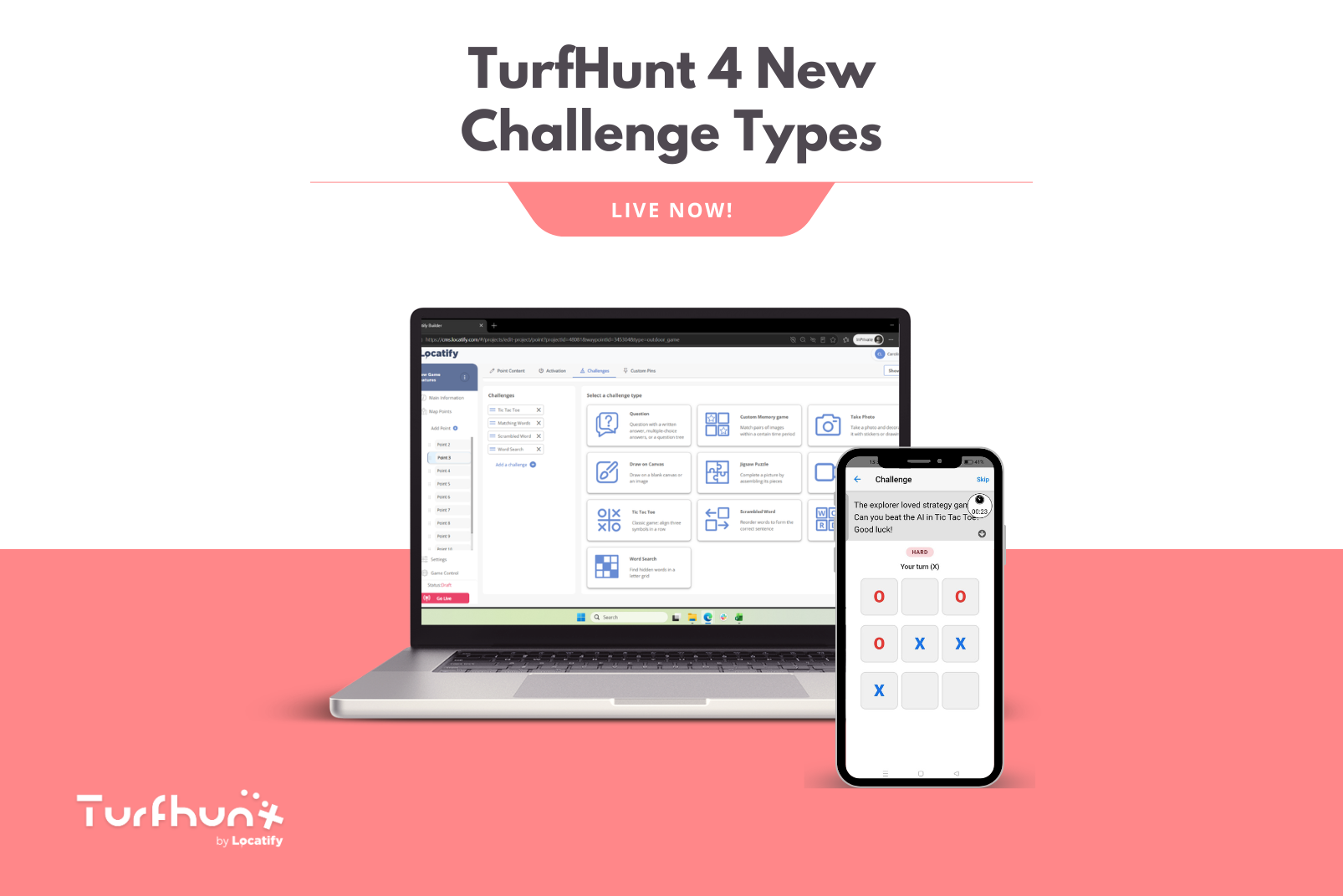
Digital platforms designed for team-based scavenger hunts — such as TurfHunt by Locatify — allow corporate event organizers to build GPS-triggered clue sequences that guide teams through office campuses, city neighborhoods, or conference venues. Each checkpoint delivers the next challenge automatically when a team’s device enters the designated radius, removing the logistical burden of physically distributing clue cards across a large area. Teams can complete photo submissions, answer trivia questions, and record video evidence directly through the app, with results compiled in a real-time dashboard that the event organizer can monitor throughout.
How to Write Original Scavenger Hunt Clues: A Design Framework
Designing original clues requires clarity about three things before writing a single word: the location or object being described, the participant profile, and the desired difficulty level. Once those are fixed, the clue writes itself more readily.
Start with the answer, work backward. Identify the location or object first. Then ask: what is distinctive about it? What can be described without naming it directly? What associations does it have — historical, sensory, functional — that could form the basis of a riddle?
Match abstraction to age. The abstraction level of a clue — how indirectly the answer is described — should match the cognitive capacity and patience of the participant. Young children need one clear sensory detail. Adults can handle multiple layers of misdirection.
Test for solvability. A clue that no one can solve is not a difficult clue — it is a broken one. Every clue should have a clear logical path from the description to the answer, even if that path requires effort. Run each clue past someone unfamiliar with the hunt before using it.
Vary the format. A hunt that uses only riddle clues becomes predictable. Mix riddles with photo missions, trivia questions, physical tasks, and GPS checkpoints to create a varied experience that keeps participants alert and engaged throughout.
Build in moments of delight. The best scavenger hunt clues produce a specific feeling when solved: the satisfaction of having figured something out. Design for that moment. A clue that is too easy produces no satisfaction; one that is too hard produces frustration. The target is the narrow band where effort meets reward.
Taking Scavenger Hunt Clues Digital
Paper clue sheets have their place, but digital platforms unlock formats — GPS triggers, photo submission, real-time leaderboards, video challenges — that paper cannot support. For hunts that take place across large outdoor areas, involve multiple simultaneous teams, or need to be reused for different groups across multiple dates, a digital platform removes the logistical overhead that can make paper-based hunts difficult to manage at scale.
TurfHunt by Locatify (turfhunt.locatify.com) allows organizers to build custom scavenger hunt experiences with GPS-anchored clues, photo and video submission missions, trivia challenges, and real-time team tracking — all managed from a single builder interface. The same hunt can be run for a school field trip one week and a corporate team-building event the next, with clue content adapted for each audience without rebuilding the location structure from scratch. For organizers managing hunts across varied age groups and contexts, the ability to adjust clue difficulty within a fixed geographic framework is a significant practical advantage.