
Introduction
In an era defined by hybrid work models, distributed teams, and digital-first communication, creating authentic human connection in the workplace has never been more challenging—or more essential. While video conferences and messaging platforms enable coordination, they rarely foster the deep interpersonal bonds that drive high-performing teams. Organizations seeking to strengthen collaboration, boost morale, and create shared experiences are rediscovering one of the most effective team building activities: the scavenger hunt.
Far from the childhood birthday party games many remember, modern team building scavenger hunts have evolved into sophisticated engagement tools that blend physical exploration, problem-solving, creative challenges, and real-time competition. Powered by location-based technology platforms like TurfHunt, these experiences now offer measurable outcomes, sophisticated analytics, and seamless execution whether teams gather in person, work remotely, or operate in hybrid configurations.
A well-designed scavenger hunt accomplishes multiple organizational objectives simultaneously: it breaks down communication barriers, reveals leadership potential, reinforces company culture, teaches collaboration skills, and creates positive memories that strengthen workplace relationships long after the event concludes. This comprehensive guide explores why scavenger hunts work so effectively for team building, how to design and implement successful events, and how technology platforms transform what was once a logistical challenge into a streamlined experience.
TurfHunt, developed by Locatify, leverages GPS positioning, Bluetooth beacon technology, and cloud-based content management to power interactive location-based games for teams of any size. The platform combines the spontaneity and engagement of traditional scavenger hunts with modern capabilities: real-time scoring, multimedia challenges, offline functionality, and comprehensive analytics that help organizations measure impact and continuously improve their team building programs.

What Is a Team Building Scavenger Hunt?
A team building scavenger hunt is a structured activity where participants collaborate in small groups to complete a series of challenges, solve puzzles, locate specific items or locations, and accomplish tasks within defined time limits. Unlike competitive sports that favor athletic ability or workshop exercises that can feel forced, scavenger hunts engage diverse skill sets—creativity, logic, communication, navigation, time management—ensuring every participant contributes meaningfully.
For a comprehensive overview of scavenger hunt app capabilities, see our complete guide to scavenger hunt apps.
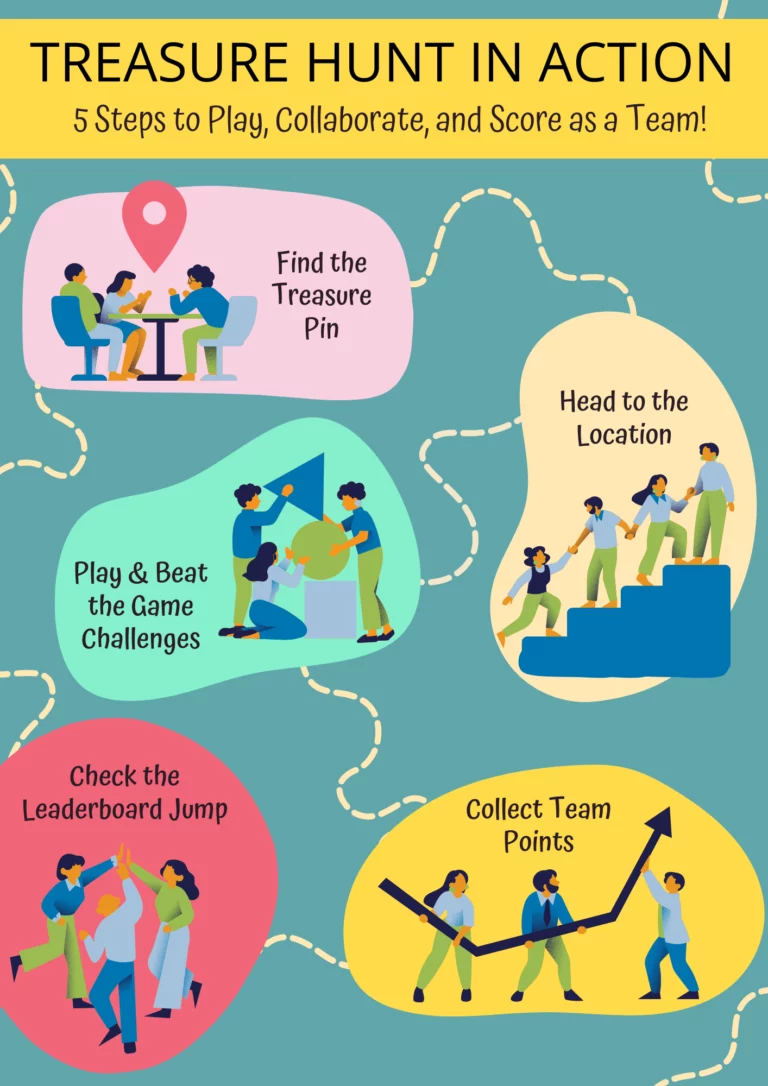
Traditional scavenger hunts provided teams with printed lists of items to find or tasks to complete, requiring manual tracking and scoring. Modern digital implementations through platforms like TurfHunt transform this concept through technology:
GPS-triggered challenges: Tasks automatically unlock as teams reach specific geographic coordinates, creating dynamic experiences that respond to physical movement.
Multimedia interactions: Rather than simple checklists, challenges can incorporate photos, videos, audio recordings, AR experiences, and interactive quizzes.
Real-time leaderboards: Instant feedback on team performance creates engaging competitive dynamics while allowing facilitators to monitor progress.
Automated scoring: Complex point systems, bonus objectives, and penalty mechanisms operate automatically, eliminating manual scorekeeping.
Cloud-based analytics: Comprehensive data on team performance, challenge completion rates, and participant engagement inform future event design.
The flexibility of modern scavenger hunt platforms means organizations can create experiences perfectly tailored to their objectives—whether onboarding new employees, strengthening cross-departmental relationships, reinforcing training content, or simply providing teams with an enjoyable shared experience that builds camaraderie.
The Psychology Behind Why Scavenger Hunts Build Better Teams
Understanding why scavenger hunts prove so effective for team development requires examining the psychological principles they activate. These activities aren’t merely fun diversions—they’re carefully structured experiences that address fundamental aspects of group dynamics and human motivation.
Collaboration Under Authentic Conditions
Workplace collaboration often occurs in artificial contexts: scheduled meetings, structured brainstorming sessions, formal presentations. While necessary, these environments rarely reveal how team members naturally work together under pressure, make spontaneous decisions, or leverage each other’s strengths.
Scavenger hunts create authentic collaboration scenarios. Teams must quickly assess challenges, delegate responsibilities based on individual capabilities, coordinate movement through physical or digital spaces, and make time-sensitive decisions with incomplete information. These mirror real workplace challenges while feeling playful rather than stressful, allowing participants to practice collaboration skills in low-stakes environments.
Research in experiential learning demonstrates that skills developed through active, contextual practice transfer more effectively to real-world application than those learned through passive instruction. A team that learns to communicate efficiently while solving scavenger hunt puzzles builds neural pathways and behavioral patterns directly applicable to workplace collaboration.
Breaking Down Hierarchical Barriers
Organizational hierarchies serve important functions but can inhibit open communication and idea sharing. Junior employees may hesitate to voice opinions to senior leaders; different departments may view each other through stereotypes rather than individual relationships.
Scavenger hunts temporarily suspend these hierarchies. When a marketing manager and an entry-level developer collaborate to decode a riddle or capture a creative photo, their organizational positions become irrelevant—only their contributions to the immediate challenge matter. This creates opportunities for relationship building that formal workplace settings rarely provide.
Many organizations specifically design cross-functional scavenger hunt teams, pairing individuals who rarely interact professionally. The shared experience and positive associations created during the activity facilitate future collaboration when these individuals encounter each other in work contexts.
Activating Multiple Intelligence Types
Howard Gardner’s theory of multiple intelligences recognizes that people possess different cognitive strengths: linguistic, logical-mathematical, spatial, bodily-kinesthetic, musical, interpersonal, intrapersonal, and naturalistic. Traditional team building exercises often emphasize only narrow intelligence types—trust falls favor physical courage, trivia contests reward factual knowledge, brainstorming sessions privilege verbal fluency.
Well-designed scavenger hunts engage multiple intelligence types simultaneously. A single event might include:
- Logical-mathematical challenges: Puzzles, code-breaking, strategic route planning
- Spatial intelligence: Navigation, map reading, location memory
- Interpersonal intelligence: Negotiation, persuasion, team coordination
- Bodily-kinesthetic: Physical tasks requiring coordination and movement
- Linguistic intelligence: Wordplay, creative storytelling, communication tasks
- Creative challenges: Photography, improvisation, artistic expression
This diversity ensures every team member finds challenges aligned with their strengths while also stretching into areas of development. Introverts who might struggle with forced social icebreakers often excel at analytical puzzle-solving; creative individuals shine during improvisation challenges; detail-oriented team members prevent groups from missing important clues.
The Neurochemistry of Play and Learning
When people engage in enjoyable, goal-oriented activities, their brains release dopamine—a neurotransmitter associated with pleasure, motivation, and memory formation. This neurochemical response serves evolutionary purposes, reinforcing behaviors that lead to success and survival.
Scavenger hunts trigger dopamine release through multiple mechanisms:
- Achievement: Completing challenges and earning points provides immediate positive feedback
- Progress: Advancing through missions creates a satisfying sense of momentum
- Competition: Friendly rivalry with other teams activates reward systems
- Social bonding: Collaboration and shared laughter release oxytocin, strengthening interpersonal connections
- Novelty: Exploring new environments and encountering unexpected challenges maintains engagement
This neurochemical context enhances learning and memory. Information encountered during positive emotional states encodes more effectively into long-term memory. Teams are more likely to remember communication lessons learned during an engaging scavenger hunt than from a traditional workshop lecture.
Revealing Leadership in Authentic Contexts
Identifying leadership potential through formal assessments or interviews provides limited insight compared to observing how individuals naturally respond to challenges. Scavenger hunts create organic opportunities for leadership to emerge.
Some team members naturally assume coordinator roles, organizing team efforts and delegating tasks. Others demonstrate leadership through expertise—navigational skills, creative problem-solving, or strategic thinking. Still others lead through encouragement, maintaining team morale and resolving conflicts.
HR professionals and managers observing scavenger hunt participation gain valuable insights about individuals’ leadership styles, stress responses, interpersonal skills, and problem-solving approaches—information that informs professional development planning, project team composition, and succession planning.
Types of Team Building Scavenger Hunts
The versatility of scavenger hunts as a team building format allows adaptation to virtually any context, objective, or constraint. Understanding different implementation models helps organizations select approaches aligned with their specific needs.
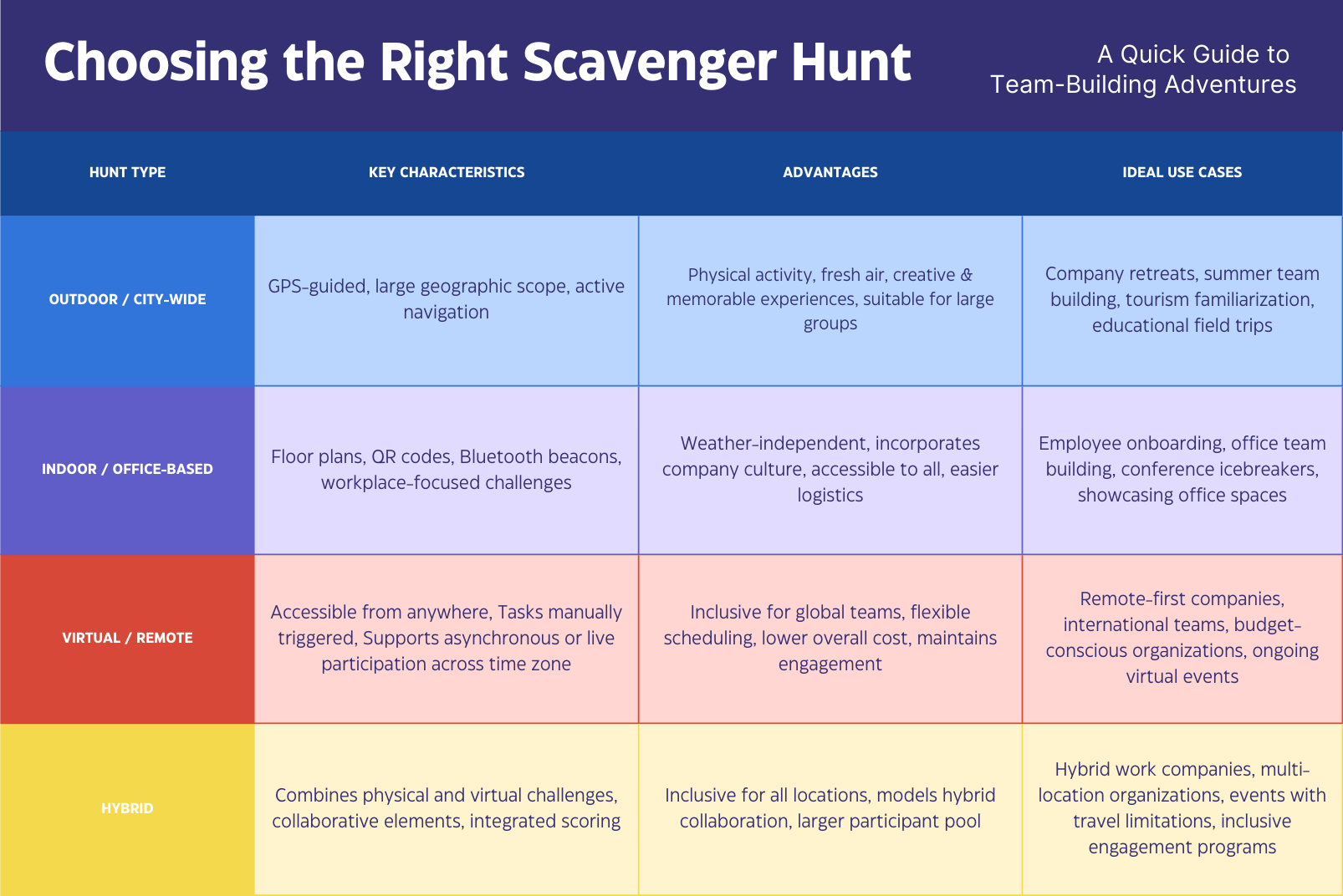
Outdoor and City-Wide Scavenger Hunts
Outdoor scavenger hunts leverage GPS technology to guide teams through parks, urban areas, campuses, or natural environments. TurfHunt’s location-based platform excels in this format, using geofencing to trigger challenges automatically as teams reach designated coordinates.
Advantages:
- Physical activity and fresh air boost energy and mood
- Exploring new environments creates memorable shared experiences
- Larger geographic scope allows for more diverse challenges
- Natural settings reduce stress and enhance creativity
- Suitable for large groups that can spread across extensive areas
Implementation considerations:
- Weather contingency planning essential
- Ensure all locations are safely accessible
- Consider physical ability variations when designing routes
- Mobile connectivity may be limited in some outdoor areas—choose platforms like TurfHunt that function offline
- Permit requirements for certain public spaces
Ideal for: Company retreats, summer team building events, tourism-industry familiarization programs, educational field trips, community engagement initiatives.
Indoor and Office-Based Scavenger Hunts
Transforming workplace environments into scavenger hunt venues offers convenience while helping employees see familiar spaces through fresh perspectives. These hunts can incorporate company culture elements, requiring teams to locate specific artifacts, answer questions about organizational history, or complete challenges tied to different departments.
Advantages:
- No weather concerns or transportation logistics
- Controlled environment simplifies facilitation
- Lower cost and complexity than external venues
- Incorporates company culture and workplace familiarization
- Accessible to all employees regardless of physical ability
Implementation considerations:
- Bluetooth beacons provide precise indoor positioning where GPS fails
- Ensure challenges don’t disrupt ongoing business operations
- Consider security and access restrictions to certain areas
- Design challenges that respect workplace professionalism
- Limited physical scope may restrict creativity—compensate with diverse challenge types
Ideal for: Onboarding programs, regular team building during work hours, conference and meeting icebreakers, late-day Friday activities, companies with impressive office spaces worth showcasing.
Virtual Scavenger Hunts for Remote Teams
The rise of distributed workforces created demand for team building activities that don’t require physical proximity. Virtual scavenger hunts adapt the core concept to digital environments, challenging remote participants to complete online tasks, find information, create content, or accomplish challenges in their home environments.
TurfHunt’s platform supports virtual hunts through:
- Photo and video submission challenges viewable on shared leaderboards
- Digital puzzle-solving and trivia competitions
- “Scavenger hunt from home” tasks (find household items, create specific photos)
- Integration with video conferencing for live challenge presentations
- Asynchronous participation allowing global teams to engage across time zones
Advantages:
- Inclusive for fully remote organizations
- No geographic limitations—global teams participate equally
- Lower cost than in-person events
- Flexible scheduling accommodating different time zones
- Maintains engagement for distributed teams feeling isolated
Implementation considerations:
- Technology requirements (stable internet, capable devices, specific apps)
- Different home environments create unequal challenge difficulty
- Reduced physical activity compared to outdoor hunts
- Require creative challenge design to maintain engagement without physical exploration
- Time zone considerations for real-time versus asynchronous formats
Ideal for: Remote-first companies, international teams, pandemic or severe weather contingencies, organizations with limited team building budgets, ongoing engagement programs with regular virtual events.
Hybrid Scavenger Hunts Connecting In-Person and Remote Participants
As hybrid work models become standard, team building activities must bridge physical and virtual participation. Hybrid scavenger hunts design challenges that both office-based and remote team members can complete, often incorporating collaborative elements requiring coordination between distributed teammates.
Implementation strategies:
- Parallel challenge tracks: office teams complete physical tasks while remote teams tackle digital challenges, with combined scoring
- Interdependent challenges: physical teams gather information that remote teams use to solve puzzles, or vice versa
- Digital collaboration tools: all participants share progress, photos, and communications through the TurfHunt platform regardless of location
- Virtual bonus opportunities: remote participants can earn extra points by supporting in-person teams through research or remote assistance
Advantages:
- Truly inclusive—no one excluded based on location
- Models real hybrid workplace collaboration
- Larger potential participant pool than location-restricted events
- Demonstrates organizational commitment to remote employee engagement
Implementation considerations:
- Complex facilitation requiring coordination of multiple formats simultaneously
- Technology infrastructure must reliably connect distributed participants
- Challenge design requires careful balancing to ensure fairness
- May require larger facilitation teams managing both physical and virtual components
Ideal for: Companies embracing permanent hybrid work models, organizations with multiple office locations, events where travel limitations prevent some employees from attending in person, progressive companies modeling inclusive remote engagement.
Themed and Purpose-Driven Scavenger Hunts
Adding thematic elements or connecting hunts to broader organizational initiatives transforms them from generic team building into meaningful experiences aligned with company values and objectives.
Popular themes and purposes:
Sustainability and CSR hunts: Challenges focused on environmental awareness, community service, charitable activities, or sustainable practices. Teams might collect recyclable materials, learn about local ecology, support community organizations, or complete carbon-neutral challenges.
Diversity and inclusion themes: Activities designed to build cultural awareness, celebrate heritage months, explore neighborhood diversity, or learn about accessibility challenges.
Innovation and creativity challenges: Tasks requiring inventive problem-solving, product ideation, creative expression, or entrepreneurial thinking—reinforcing organizational innovation priorities.
Health and wellness focus: Incorporating fitness challenges, mental health awareness, nutrition education, or stress management techniques while maintaining the playful scavenger hunt framework.
Historical and educational themes: Particularly effective for museums, educational institutions, or heritage tourism organizations, combining team building with authentic learning objectives.
Holiday and celebration events: Seasonal hunts (Halloween, winter holidays, summer kickoffs) that maintain team building benefits while embracing festive atmospheres.
Thematic elements provide narrative coherence that enhances engagement and creates opportunities to subtly reinforce organizational values and priorities within enjoyable contexts.
How to Plan a Successful Team Building Scavenger Hunt
Executing an effective scavenger hunt requires careful planning across multiple dimensions. Drawing from TurfHunt implementation experience across diverse organizations, the following framework ensures successful events that achieve intended outcomes while avoiding common pitfalls.
Step 1: Define Clear Objectives and Success Metrics
Before designing any specific challenges, clarify what the scavenger hunt should accomplish:
Team building and relationship strengthening: Fostering connections between colleagues who rarely interact, breaking down departmental silos, helping new employees integrate into existing teams.
Skills development: Practicing specific competencies like communication, problem-solving, time management, or creative thinking in applied contexts.
Cultural reinforcement: Demonstrating and celebrating organizational values, mission, or cultural principles through themed challenges.
Knowledge transfer: Onboarding new employees by familiarizing them with company history, facilities, resources, or procedures through experiential exploration.
Morale and engagement: Providing enjoyable shared experiences that boost satisfaction, reduce stress, and demonstrate organizational investment in employee well-being.
Assessment and identification: Observing leadership potential, team dynamics, or individual capabilities in authentic situations.
Specific, measurable objectives enable evaluation of event success beyond participants simply reporting they “had fun.” Success metrics might include:
- Participation rates and completion percentages
- Post-event survey scores on specific dimensions (enjoyment, learning, relationship building)
- Behavioral changes observed after the event (increased cross-departmental collaboration, improved communication)
- Performance on knowledge assessments if learning objectives were primary goals
Step 2: Choose the Appropriate Platform and Technology
While scavenger hunts can be executed with paper lists and manual scoring, technology platforms like TurfHunt dramatically enhance experience quality, reduce facilitation burden, and enable data collection that manual methods cannot match.
Essential platform capabilities to evaluate:
Location technology: GPS for outdoor environments, or Bluetooth beacons for indoor positioning (or outdoor beacons for compact spaces). Note that combining GPS and indoor beacons requires separate project configurations.
Challenge variety: Support for multiple task types including photo missions, trivia questions, video submissions, creative prompts, physical challenges, and puzzle-solving.
Content management: Intuitive interface allowing non-technical organizers to create, edit, and manage hunt content without developer assistance. The Locatify Builder powering TurfHunt provides visual editors and template systems that accelerate event creation.
Scoring flexibility: Configurable point systems, time-based bonuses, and penalty mechanisms for incorrect answers. Game masters can manually adjust scores after events to reward specific achievements (most creative submission, best teamwork, etc.).
Real-time interaction: Live leaderboards, instant feedback on challenge completion, and participant-to-facilitator communication channels.
Offline functionality: Critical for outdoor environments or venues with unreliable connectivity—participants should complete challenges without constant internet access, with automatic synchronization when connectivity returns.
Analytics and reporting: Comprehensive data on team performance, challenge difficulty, engagement patterns, and participant feedback that inform continuous improvement.
Scalability: Capability to support anywhere from small 10-person teams to enterprise-scale events with hundreds or thousands of participants across multiple locations.
Administrative control: Live monitoring dashboards allowing facilitators to track all teams, adjust scoring, provide hints, and manage the event in real-time.
Step 3: Design Engaging, Balanced Challenges
Challenge design makes or breaks scavenger hunt experiences. The most effective events incorporate diverse task types that engage different skills while maintaining appropriate difficulty progression.
Challenge categories to include:
Knowledge and trivia: Questions testing company knowledge, general trivia, or subject matter expertise relevant to organizational context. These work well as quick “transition” challenges between more complex tasks.
Photo missions: “Capture an image that represents…” or “Take a team photo at…” challenges. These generate sharable content, encourage creativity, and work well in both physical and virtual formats.
Creative and performance tasks: Improvisation challenges, creating short videos, composing songs or poems, building structures from found materials. These reveal creative thinking and often generate the most memorable moments.
Physical and coordination challenges: Tasks requiring dexterity, teamwork coordination, or minor physical activity (nothing that excludes participants with mobility limitations). Balance physical elements to energize without exhausting participants.
Problem-solving and puzzles: Riddles, codes to decipher, logic problems, or strategy games that reward analytical thinking and collaboration.
Exploration and discovery: Location-finding tasks, scavenger elements where teams must locate specific objects or landmarks, or information-gathering missions requiring interaction with the environment.
Social interaction challenges: Tasks requiring teams to engage with other people—interviewing strangers, gathering signatures, or collaborative challenges with other teams.
Difficulty progression principles:
Start with simple, confidence-building challenges that ensure immediate success and engagement. Early wins generate momentum and enthusiasm.
Gradually increase complexity as teams warm up and develop collaborative rhythms. Middle challenges should stretch capabilities without frustrating participants.
Include optional “bonus challenges” for advanced teams seeking extra competition without making completion impossible for average performers.
End with a climactic final challenge that feels significant and provides satisfying closure.
Balance “solo” tasks (where individuals can contribute independently) with challenges explicitly requiring full team collaboration.
TurfHunt’s challenge builder includes templates for common task types, making it easy to create diverse, engaging hunt experiences without starting from scratch.
Step 4: Build Compelling Narratives and Themes
While not strictly necessary, narrative frameworks significantly enhance engagement by providing context and meaning to otherwise arbitrary challenges. Strong narratives transform a series of disconnected tasks into a cohesive journey or mission.
Effective narrative approaches:
Mystery and investigation: Teams work as detectives solving a crime, uncovering a conspiracy, or investigating a historical mystery. Each challenge reveals clues toward the ultimate solution.
Adventure and quest: Participants embark on heroic journeys—recovering lost artifacts, saving the company from disaster, or completing epic missions tied to company mythology.
Time travel and history: Especially effective for organizations with rich histories or educational contexts—teams “travel” through different eras, learning historical facts while completing period-appropriate challenges.
Competition and achievement: Frame the hunt as a championship, competition, or achievement system where teams earn ranks, unlock levels, or compete for prestigious titles.
Company-specific narratives: Customize stories to organizational context—new product launches might inspire innovation-themed hunts, milestone anniversaries could trigger historical explorations, corporate values might personify as characters guiding teams through themed challenges.
Well-executed narratives don’t need Hollywood budgets—simple storytelling through challenge descriptions, thematic imagery in the TurfHunt app interface, and facilitator narration during briefings effectively establish immersive contexts.
Step 5: Technical Setup and Testing
Technology failures destroy otherwise excellent events. Thorough technical preparation and testing prevent embarrassing malfunctions.
Pre-event technical checklist:
Location accuracy verification: For GPS-based hunts, physically visit challenge locations with devices running the TurfHunt app. Verify that geofences trigger reliably and locations are accurately marked. For indoor events using Bluetooth beacons, conduct signal strength testing and calibration.
Content review: Proofread all challenge text, verify image and video assets display correctly, confirm answer validation logic works as intended (especially for free-text responses), and test that point awards calculate properly. Use TurfHunt’s test mode to preview the game on your phone without needing to be at the actual GPS locations.
Network assessment: Identify areas with poor connectivity. Configure the TurfHunt app for offline operation in these zones, ensuring challenges complete locally and sync when connectivity returns.
Device preparation: If providing devices to participants, ensure adequate charging, app installation and login credentials, necessary permissions (location services, camera, microphone), and consistent settings across all devices.
Pilot run: Conduct a complete test event with a small group days before the actual hunt. This reveals unclear instructions, timing issues, unintended challenge difficulties, and technical problems in authentic use conditions.
Organizers can test the complete experience directly in the TurfHunt app before publishing to participants, ensuring all challenges, triggers, and content function as intended.
Step 6: Event Facilitation and Real-Time Management
Even with excellent planning, effective facilitation during the event ensures smooth execution.
Pre-event briefing: Gather all participants for clear instructions covering:
- Objectives and schedule
- Team assignments (if not pre-determined)
- App usage instructions and technology troubleshooting basics
- Safety guidelines and boundaries
- Scoring system and competition rules
- Communication protocols for questions or emergencies
Communication management:
- Broadcast hints: Send hints or announcements to all teams simultaneously (individual team messaging not available due to privacy policies)
- Time control: Game master can manually end the game, or set a predefined end time before launch. Games can also run continuously for extended periods (weeks/months) if no duration limit is set
Support availability: Designated support contacts available via messaging within the TurfHunt app or physical presence at central locations to assist with technical problems or questions.
Important limitation: Once a game is published and players begin, challenges cannot be modified or skipped without requiring players to restart. All content and challenge sequences must be finalized before launch.
Step 7: Debriefing, Recognition, and Analysis
The scavenger hunt’s conclusion presents opportunities to maximize learning, celebrate achievement, and gather improvement insights.
Structured debriefing: Rather than simply announcing winners, facilitate reflection:
- What strategies proved most effective?
- How did teams handle disagreements or challenging moments?
- What did participants learn about themselves or teammates?
- How might collaboration approaches apply to actual work contexts?
- What surprising skills or leadership emerged?
Recognition beyond winning: Acknowledge diverse achievements:
- Most creative photo submission
- Best teamwork and communication
- Most improved team (if running recurring events)
- Spirit award for enthusiasm and positive attitude
- Specific individual recognitions for notable contributions
Immediate feedback collection: While the experience remains fresh, gather participant feedback through:
- Quick digital surveys assessing enjoyment, learning, and suggestions
- Open discussion of what worked well and what could improve
- Specific questions about challenge difficulty and variety
- Technical experience and any problems encountered
- Photo gallery showcase: Display submitted images from the game on a screen (great for post-event celebrations or dinners), creating a visual recap that reinforces shared memories
Data analysis: The TurfHunt platform provides:
- Completion timestamps for each challenge
- Team scores and rankings
- Submitted images and media from challenges
- Ability for game masters to adjust scores after the event
This data allows organizers to review which teams completed which challenges, evaluate creative submissions through photos/videos, and make post-event scoring adjustments to recognize outstanding efforts.
Measuring Impact: From Enjoyment to Organizational Outcomes
Beyond participants enjoying themselves—itself a worthwhile goal—sophisticated team building programs measure tangible outcomes that justify continued investment.
Quantitative Metrics
Participation and engagement rates: What percentage of invited employees participated? Did certain departments or demographics participate less, indicating inclusion barriers? In recurring programs, how do participation rates trend over time?
Completion statistics: What percentage of teams finished the hunt? How many challenges did average teams complete? Were time limits appropriate?
Performance data: How did team scores distribute? Wide variance might indicate unbalanced team composition or challenge difficulty issues. Extremely high or low scores suggest calibration needs.
Qualitative Insights
Structured feedback surveys: Post-event questionnaires measuring:
- Overall satisfaction and likelihood to recommend
- Perceived impact on team relationships and communication
- Learning outcomes if educational objectives existed
- Specific feedback on challenge types, difficulty, and variety
- Suggestions for improvement
Open-ended responses: Free-form participant comments often surface insights structured questions miss—unexpected benefits, creative improvement ideas, or concerns not anticipated in survey design.
Facilitator observations: Those monitoring the event notice dynamics surveys don’t capture—leadership emergence, conflict resolution approaches, inclusivity patterns, and individual behavioral tendencies relevant to professional development.
Organizational Impact Assessment
Behavioral indicators: Observable workplace changes following scavenger hunt programs:
- Increased informal collaboration between participants from different departments
- More frequent volunteering for cross-functional projects
- Improved meeting dynamics and communication efficiency
- Reduced conflict or faster conflict resolution
Retention and satisfaction: Correlation between team building program participation and:
- Employee satisfaction scores in subsequent engagement surveys
- Retention rates compared to non-participating employees
- Reduced absenteeism or increased discretionary effort
Performance outcomes: In contexts with measurable team performance metrics:
- Project completion efficiency for teams that participated together
- Innovation metrics like ideas submitted or implemented
- Customer satisfaction scores for customer-facing teams
- Error rates or quality metrics for operational teams
Cultural alignment: Assessment of whether values emphasized in themed scavenger hunts (innovation, collaboration, sustainability) subsequently appear more frequently in employee behavior and decision-making.
While directly attributing organizational improvements solely to scavenger hunts requires careful research design, tracking these metrics over time as part of comprehensive team building programs provides evidence of impact and informs resource allocation decisions.
Real-World Applications and Success Stories
Examining how diverse organizations leverage team building scavenger hunts illustrates versatility and provides implementation inspiration.
Corporate Team Building and Cross-Functional Collaboration
A multinational technology company with 15,000 employees across 40 countries implemented quarterly TurfHunt experiences as part of their global engagement strategy. Regional offices compete in local scavenger hunts with standardized challenge templates customized to local contexts.
The program explicitly pairs employees from different departments who rarely interact professionally. Post-program surveys indicated:
- 78% of participants reported forming new professional relationships
- 64% subsequently collaborated with hunt teammates on actual projects
- Overall engagement scores increased 12% among regular participants
- The program became the highest-rated employee benefit in annual satisfaction surveys
Key success factors: Executive sponsorship normalizing participation, dedicated budget ensuring high-quality execution, consistent quarterly schedule creating anticipation, and sophisticated use of TurfHunt analytics to continuously improve experiences.
Educational Institutions and Student Orientation
A large university replaced traditional orientation programming with week-long scavenger hunt experiences for incoming students. Using TurfHunt’s beacon-enabled platform, challenges guide students through campus while introducing essential resources, academic policies, and social opportunities.
Outcomes compared to previous orientation formats:
- 94% completion rate versus 61% for traditional lecture-based orientations
- Students retained 47% more information about campus resources in assessments three months later
- First-semester dropout rates decreased 23%
- Student satisfaction with orientation increased from 3.2 to 4.6 (out of 5)
- Campus resource centers (library, tutoring, counseling) saw increased utilization from first-year students
The gamified approach transformed information delivery from boring obligation to engaging exploration, with peer collaboration in scavenger hunt teams creating immediate social connections that eased transition stress.
Non-Profit Organizations and Community Engagement
Municipal tourism boards and non-profit organizations use public scavenger hunts to drive community engagement, awareness campaigns, and fundraising. One environmental non-profit created a city-wide “Sustainability Quest” through TurfHunt, with challenges teaching eco-friendly practices while raising funds through corporate sponsorships and participation fees.
Results over three annual events:
- 12,000+ participants across all demographics
- $240,000 raised for environmental programs
- Measurable behavior change: 34% of participants reported adopting at least one new sustainable practice post-event
- Media coverage equivalent to $180,000 in advertising value
- Corporate sponsors renewed at 89% rate due to positive brand association
The scavenger hunt format transformed environmental education from preaching to entertainment, reaching audiences typically disengaged from traditional advocacy messaging.
Corporate Training and Skill Development
A financial services firm integrated scavenger hunts into compliance training—typically the driest corporate education topic. Rather than classroom lectures, teams completed challenges requiring application of regulatory knowledge, ethical decision-making, and risk assessment in realistic scenarios.
Training effectiveness comparisons:
- Knowledge retention at six months: 71% for scavenger hunt participants versus 34% for traditional training
- Training completion rates: 96% versus 78%
- Participant satisfaction: 4.5 versus 2.1 (out of 5)
- Compliance incident rates: Participants demonstrated 28% fewer violations in subsequent audits
By embedding essential learning objectives within engaging gameplay, the firm transformed mandatory training from resented obligation to anticipated event.
How TurfHunt Empowers Organizers and Participants
TurfHunt’s comprehensive platform, built on Locatify’s location technology infrastructure, addresses the full lifecycle of scavenger hunt creation, execution, and analysis. Understanding the platform’s capabilities clarifies why technology-enabled hunts dramatically outperform manual approaches.
For Organizers: Intuitive Creation and Management
The Locatify Builder powering TurfHunt provides visual, no-code tools for designing sophisticated experiences:
Visual map editing: Upload venue maps or use integrated mapping, then click to place challenge locations. The system automatically generates geofences or associates Bluetooth beacon triggers.
Challenge builder: Template-based creation for common task types (photo missions, trivia, creative prompts) with customization for specific needs. Rich media support includes images, videos and audio.
Logic and branching: Create conditional experiences where challenge sequences adapt based on team performance, choices, or random variation.
Team management: Automatic or manual team assignment, customizable team sizes, and participant invitation systems integrated with existing authentication platforms.
Scoring configuration: Complex point systems, time-based multipliers, accuracy bonuses, creativity scoring (through judge review interfaces), and penalty mechanisms—all configured without coding.
Preview and testing: Simulate the complete participant experience before publishing, including testing on actual devices in physical locations.
Real-time monitoring dashboard: During events, track all teams on live maps, monitor challenge completion, view submitted content, adjust scoring, send hints or announcements, and respond to support requests.
Post-event analytics: Comprehensive reports on participation, performance, engagement patterns, challenge difficulty, and participant feedback—exportable for stakeholder reporting or program improvement analysis.
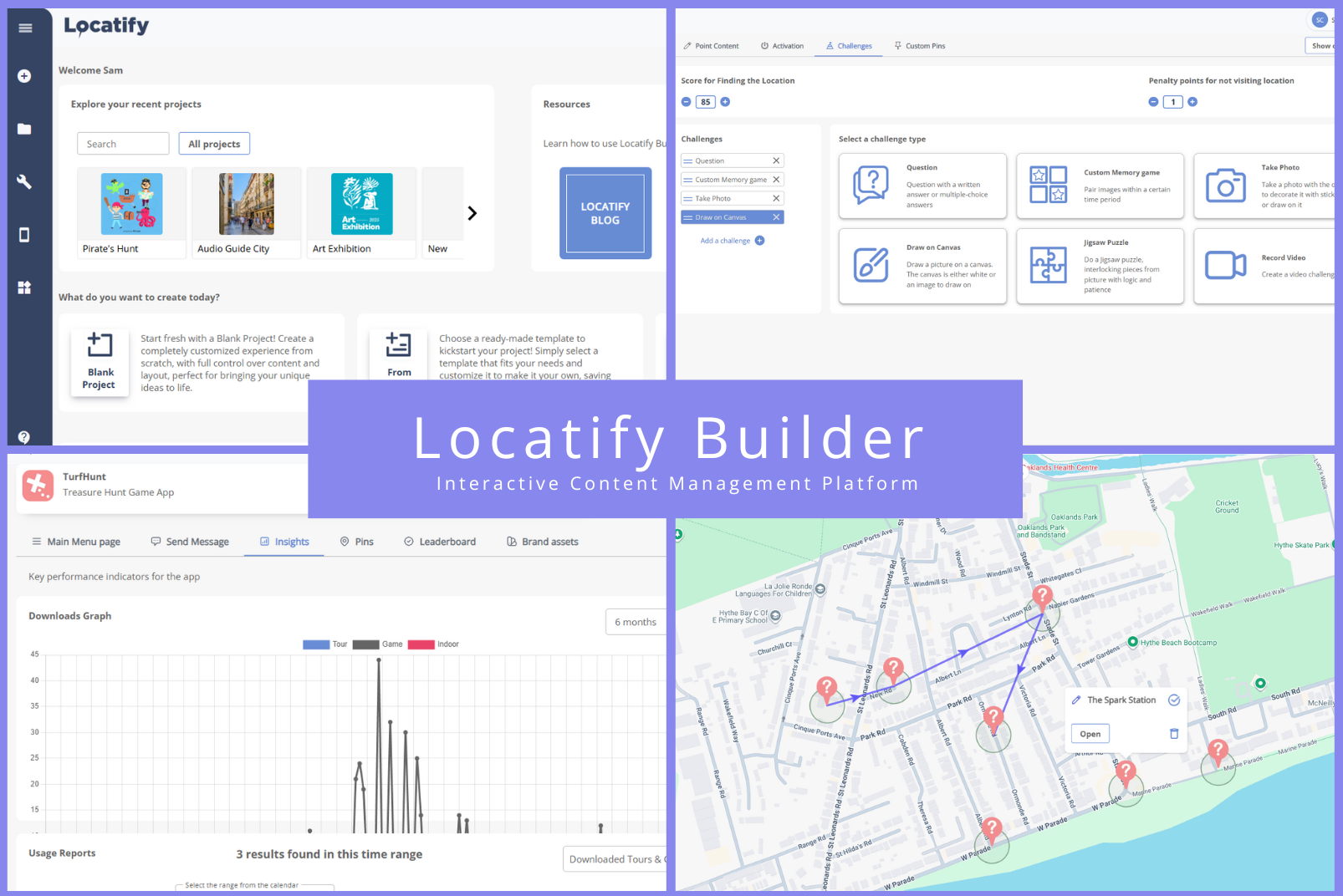
This accessible toolset means HR professionals, educators, event coordinators, and tourism managers create professional scavenger hunts themselves rather than requiring technical developers for each event—dramatically reducing costs and iteration time.
For Participants: Seamless, Engaging Experiences
The TurfHunt mobile application provides participants with intuitive interfaces that minimize technology friction while maximizing engagement:
Automated navigation: The TurfHunt app detects when teams reach challenge locations using GPS or beacons, automatically presenting relevant tasks without manual check-ins.
Multimedia challenges: Rich presentation of photos, videos, audio instructions, and interactive quiz interfaces within the app.
Easy content submission: Integrated camera and media capture for photo/video challenges with instant upload to scoring dashboards.
Live leaderboards: Real-time team rankings visible to all participants, updated automatically as challenges are completed—creating competitive motivation without requiring manual scorekeeping.
Offline functionality: Download complete hunt experiences before starting. Challenges complete without internet connectivity, automatically syncing when networks become available—essential for outdoor locations or venues with unreliable WiFi.
Broadcast messaging: Game masters can send messages to all participants simultaneously for announcements, hints, or updates without requiring external communication apps.
Progress tracking: Clear visual indicators show completed challenges, available tasks, and overall progress—preventing confusion about what to do next.
Accessibility features: Configurable text sizes, audio alternatives for visual content, and challenge modifications accommodating diverse abilities.
The platform’s technical sophistication remains invisible to participants, who experience simply: “open app, follow instructions, complete fun challenges, see how we’re doing”—the hallmark of excellent user experience design.
Integration with Broader Organizational Systems
TurfHunt integrates with existing organizational systems to streamline event management:
Single sign-on (SSO): Integration with corporate authentication systems (Azure AD, Okta, Google Workspace) eliminates separate account creation friction.
Data export: Participation data, scores, and completion information can be exported directly within the TurfHunt system for internal reporting or professional development tracking.
Communications platforms: Webhook integrations with Slack, Microsoft Teams, or email systems enable automated event reminders and results distribution.
This integration philosophy allows TurfHunt to enhance rather than disrupt existing organizational workflows and technology investments.
Advanced Strategies for Long-Term Team Building Programs
While one-off scavenger hunts deliver value, organizations achieving the greatest impact implement ongoing programs that evolve and deepen over time.
Recurring Events with Progressive Difficulty
Rather than treating scavenger hunts as annual events, leading organizations schedule regular experiences—quarterly or even monthly—that build on previous activities:
Seasonal themes: Align hunts with quarters or seasons, creating anticipation and variety while allowing reuse of tested challenge frameworks with fresh content.
Progressive complexity: Early hunts in a program series use straightforward challenges building confidence and establishing behavioral norms. Later hunts introduce greater complexity, longer timeframes, or more sophisticated collaboration requirements.
Continuity and storytelling: Create narrative continuity across events where each hunt reveals another chapter of an ongoing story, building engagement through serialized experiences.
Achievement systems: Implement badges, levels, or point accumulation across multiple events. Teams or individuals can work toward long-term recognition—”TurfHunt Champion” status, special privileges, or tangible rewards.
Cross-Organizational Competitions and Partnerships
Expanding scavenger hunts beyond single organizations creates unique engagement opportunities:
Industry competitions: Professional associations or industry groups organize multi-company tournaments, creating networking opportunities alongside competitive team building.
Client engagement events: B2B companies use scavenger hunts during client conferences, partner meetings, or customer appreciation events—strengthening business relationships through shared experiences.
Charity and CSR partnerships: Align scavenger hunts with non-profit organizations, where participation fees support causes, challenges incorporate service elements, or events raise awareness for social issues—adding purpose alongside entertainment.
Academic-corporate partnerships: Companies partner with universities for recruitment-focused scavenger hunts where student teams compete while learning about corporate culture and opportunities.
Data-Driven Continuous Improvement
Sophisticated programs leverage TurfHunt analytics for systematic refinement:
Challenge optimization: Analyze completion rates, time spent, and participant feedback for each challenge. Retire consistently weak performers, refine those with potential, and replicate successful formats.
Difficulty calibration: Track score distributions to ensure challenges neither frustrate with excessive difficulty nor bore with inadequacy. Aim for distributions where most teams complete 70-85% of challenges—enough success for satisfaction with sufficient challenge for engagement.
Personalization through segmentation: Analyze performance patterns across demographic segments (departments, roles, tenure). Design challenge variations addressing specific developmental needs of different employee populations.
Predictive modeling: With sufficient historical data, identify challenge characteristics correlating with high engagement and positive outcomes. Use insights to generate evidence-based new content rather than relying solely on intuition.
A/B testing: For large organizations running parallel events, test variations systematically—different challenge types, scoring mechanisms, team compositions, or facilitation approaches—to identify optimal configurations.
Integration with Broader Development Programs
Maximum impact occurs when scavenger hunts integrate with comprehensive talent development strategies:
Leadership development programs: Incorporate hunts where emerging leaders serve as team facilitators or challenge designers—developing planning, communication, and group management skills.
Onboarding journeys: Multi-stage scavenger hunts across first days, weeks, and months systematically introduce new employees to expanding organizational knowledge.
Performance improvement plans: For teams experiencing collaboration difficulties, carefully designed scavenger hunts diagnose communication breakdowns and provide low-stakes practice in improved interaction patterns.
Succession planning: Observation of employees in scavenger hunt leadership roles informs identification of high-potential talent for advancement opportunities.
Cultural transformation initiatives: When organizations seek culture change—becoming more innovative, collaborative, or customer-focused—themed scavenger hunts model and reinforce desired behavioral norms.
The Future of Team Building Scavenger Hunts
Technology and workplace trends will continue evolving team building practices. Forward-looking organizations prepare for emerging capabilities while ensuring current programs remain effective.
Augmented and Virtual Reality Integration
As AR glasses approach mainstream adoption and VR technology improves, scavenger hunts will incorporate immersive digital overlays:
AR-enhanced challenges: Physical locations trigger holographic content—historical reconstructions at heritage sites, virtual characters providing clues, or digital objects teams must “collect” at physical locations.
Mixed reality collaboration: Remote team members participate through VR representations that appear alongside physical participants, creating seamless hybrid experiences where location becomes irrelevant.
Environmental storytelling: AR transforms ordinary spaces into fantasy worlds, historical periods, or branded environments—dramatically expanding creative possibilities without physical construction.
TurfHunt’s development roadmap includes AR authoring tools allowing content creators to design location-anchored digital experiences through visual editors rather than requiring 3D modeling expertise.
Artificial Intelligence and Adaptive Experiences
Machine learning will enable scavenger hunts that personalize in real-time:
Dynamic difficulty adjustment: AI analyzes team performance during events and adjusts subsequent challenge difficulty, ensuring optimal engagement regardless of initial capability assessments.
Intelligent hint systems: Rather than generic hints available to all teams, AI provides contextual assistance calibrated to specific struggles—enough support to prevent frustration without eliminating challenge satisfaction.
Predictive content recommendations: Machine learning identifies which challenge types engage specific participants most effectively based on behavioral patterns, enabling personalized experiences even within group activities.
AI-powered content generation and voice interfaces: Locatify is developing AI capabilities for its 2026 roadmap, including generative content creation to expand challenge libraries automatically and natural language processing for voice-based interactions—making scavenger hunts more accessible and reducing organizer workload.
Biometric Integration and Wellness Focus
Wearable device integration will enable new challenge categories and wellness applications:
Fitness and movement tracking: Challenges incorporating step counts, heart rate zones, or activity levels—gamifying workplace wellness initiatives through team building events.
Stress and recovery monitoring: Understanding participant stress responses during events informs challenge design that maintains engagement without creating counterproductive anxiety.
Team synchronization: Biometric data revealing when teams achieve “flow states” or peak collaboration—insights applicable to optimizing real workplace team configurations.
Health-focused team building: Scavenger hunts explicitly designed around wellness goals—mindfulness challenges, nutrition education, ergonomic awareness, or mental health destigmatization.
Sustainability and Environmental Responsibility
Growing environmental consciousness will reshape event design:
Carbon-neutral events: Route planning minimizing transportation impacts, digital challenges replacing physical materials, and carbon offset integration for unavoidable emissions.
Educational environmental content: Challenges teaching sustainability principles, highlighting local ecology, or incorporating conservation activities.
Circular economy principles: Event materials designed for reuse across multiple hunts, equipment sharing programs, and elimination of single-use items.
Virtual alternatives: High-quality virtual experiences reducing need for travel-intensive in-person events when relationship building needs are secondary to entertainment or light engagement.
Blockchain and Decentralized Recognition
Emerging technologies may enable new recognition models:
Portable achievement credentials: Blockchain-verified certificates of scavenger hunt accomplishments transferable across employers—building personal portfolios of demonstrated capabilities.
Decentralized team building networks: Cross-organizational platforms where professionals participate in mixed-company hunts, expanding professional networks while building skills.
Digital achievement rewards: TurfHunt already supports rewarding players with digital vouchers (in image format) when they reach specific point thresholds or complete a certain number of challenges providing portable proof of accomplishment that appeals to digital-native participants.
While some emerging technologies remain speculative, organizations benefit from awareness of trajectories that may reshape team building practices within 3-5 year horizons.
Conclusion
Team building scavenger hunts represent far more than playful diversions from work routines. When thoughtfully designed and professionally executed, they function as sophisticated development tools addressing fundamental challenges facing modern organizations: building trust across distributed teams, developing collaboration skills in authentic contexts, reinforcing cultural values through experiential learning, and creating positive memories that strengthen workplace relationships.
The evolution from paper checklists to intelligent platforms like TurfHunt has democratized access to professional-quality experiences. Organizations of any size can now design, deploy, and analyze scavenger hunts with capabilities previously requiring expensive external facilitators or technical development resources. The Locatify Builder provides the authoring power, TurfHunt delivers engaging participant experiences, and comprehensive analytics enable evidence-based continuous improvement.
Success with team building scavenger hunts requires more than technology—it demands clear objective-setting, creative challenge design, thoughtful facilitation, and integration with broader talent development strategies. Organizations treating scavenger hunts as isolated events capture only a fraction of potential value compared to those implementing systematic programs that evolve based on participant feedback and performance data.
As workplaces continue fragmenting across locations, generations, and work modalities, the need for meaningful human connection intensifies. Team building scavenger hunts answer this need by creating shared experiences that transcend the limitations of video conferences and email threads. They remind us that beneath organizational charts and job titles exist real humans who collaborate more effectively after they’ve solved puzzles together, laughed at shared absurdities, and celebrated collective achievements.
Whether you’re an HR professional seeking engagement solutions, an educator designing experiential learning, a tourism professional creating destination experiences, or an event organizer planning memorable activities—team building scavenger hunts offer versatile, proven, and increasingly sophisticated tools for bringing people together in meaningful ways.
Discover how TurfHunt’s platform can transform your team building programs through intelligent, location-based experiences powered by Locatify’s award-winning technology.
For implementation guidance and to explore TurfHunt’s full capabilities, visit the TurfHunt Team Building page and TurfHunt Features page. Technical documentation and integration resources are available through the Locatify Builder overview.